
In case you missed it see what’s in this section
We recommend

eating & drinking
Sponsored by

lifestyle
Sponsored by

entertainment
Sponsored by
Business
Sponsored by
jobs
Sponsored by

property
Sponsored by
family
Sponsored by
shopping
Sponsored by

sport
Sponsored by

motoring
Sponsored by


Your Total Guide To Business
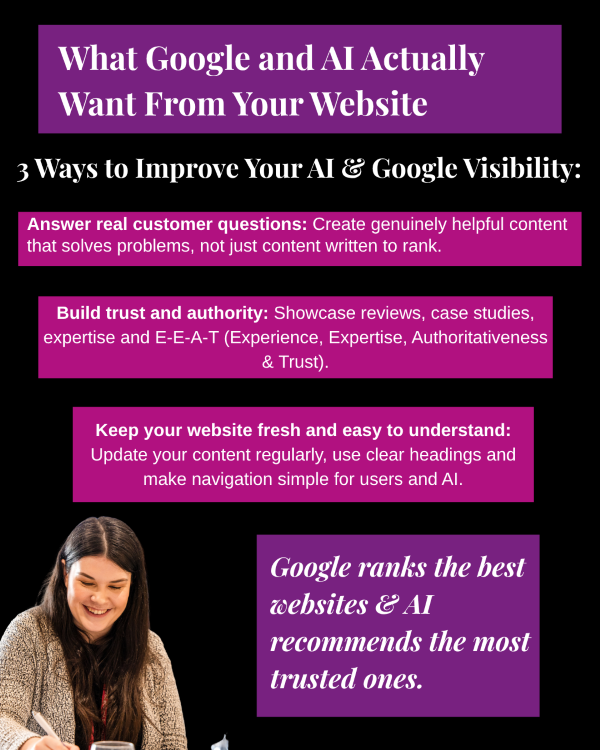
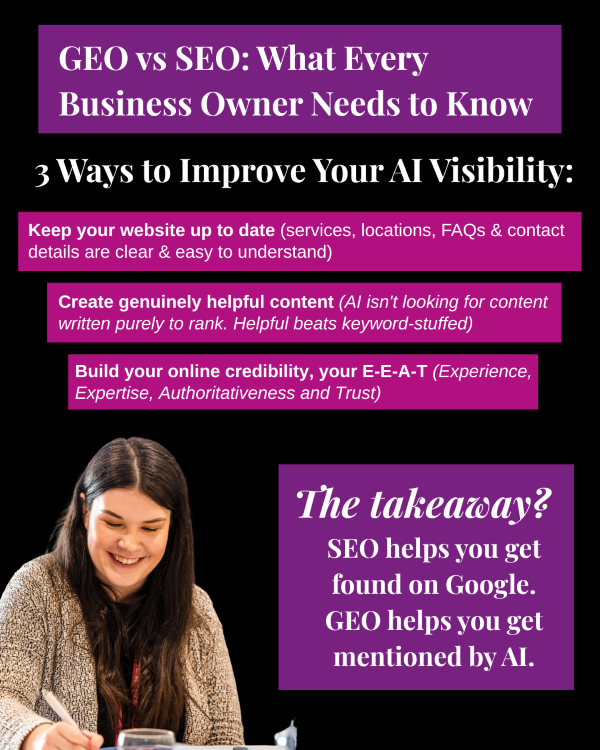
The good news? Google and AI platforms are looking for many of the same signals. The businesses that provide the most useful, trustworthy and well-structured information are the ones most likely to be recommended.
Here's what they really want from your website.
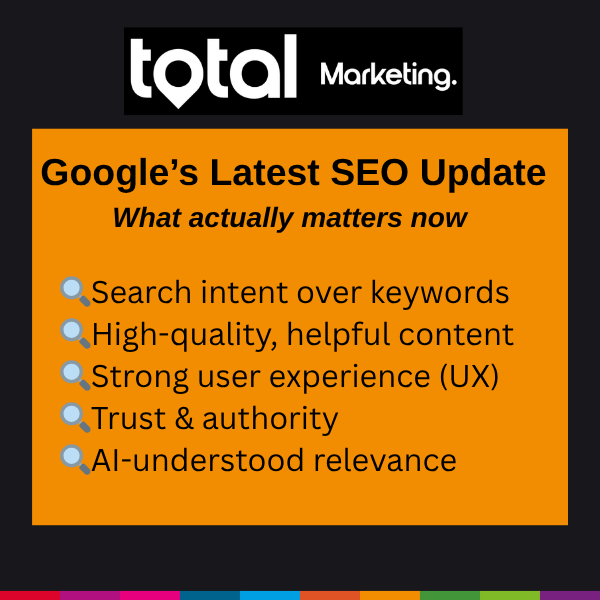
The days of stuffing pages with keywords are long gone.
Google and AI models prioritise content that genuinely helps users answer a question or solve a problem. Every page should have a clear purpose and provide valuable information that is easy to understand.
Ask yourself:
Content written for people will always outperform content written purely for search engines.
Google places significant emphasis on Experience, Expertise, Authoritativeness and Trustworthiness (often referred to as E-E-A-T).
AI systems also look for signals that your business knows what it's talking about.
You can strengthen this by:
The more evidence you provide that you're an expert in your field, the more confidence search engines and AI have in recommending your business.
AI doesn't browse your website like a human.
It needs pages that are organised logically and easy to interpret.
That means:
A well-structured website helps both users and search engines understand what each page is about.
Outdated content can reduce trust.
Google favours websites that are regularly updated, and AI systems are more likely to recommend businesses with current, accurate information.
Regularly review:
Even refreshing existing content can improve visibility.
A slow website creates a poor user experience.
Google has used page speed as a ranking signal for years, and AI tools often reference websites that are technically strong and accessible.
Focus on:
Technical SEO still matters.
AI platforms love content that directly answers specific questions.
Rather than only creating service pages, think about what your customers ask every day.
For example:
Creating detailed FAQ sections and informative articles increases your chances of appearing in both Google search results and AI-generated answers.
Every page on your website should support another.
Internal links help search engines discover your content, understand relationships between topics and pass authority throughout your site.
For example, a service page could naturally link to:
This creates a stronger overall website rather than a collection of isolated pages.
Google and AI are looking for evidence that you're a legitimate, reliable business.
Include:
Trust is becoming one of the biggest differentiators in AI search.
AI can recognise when websites simply repeat what everyone else is saying.
The businesses that stand out share:
Original content gives AI a reason to reference your business over competitors.
Your website doesn't exist in isolation.
Google and AI compare information across multiple sources, including your website, business directories, review platforms and social media.
Ensure your:
are consistent wherever your business appears online.
SEO is no longer just about ranking on Google.
It's about becoming the business that search engines and AI assistants trust enough to recommend.
That means focusing less on trying to "game" algorithms and more on creating the best possible experience for your customers.
If your website is informative, technically sound, easy to navigate and demonstrates genuine expertise, you'll be in a much stronger position to succeed in both traditional search and the rapidly growing world of AI-powered search.
As search continues to evolve, businesses that invest in high-quality content and trust-building today will be the ones that benefit tomorrow.
We've created an AI Visibility Report, showing whether your business is appearing in tools like ChatGPT, where the opportunities are, and what you can do to improve. Scan the QR Code to have a chat with Liz.

Google looks for websites that provide helpful, accurate and trustworthy content. It also considers technical factors such as page speed, mobile usability, website security, clear site structure and high-quality backlinks.
AI search tools such as ChatGPT, Google AI Overviews and Gemini favour websites that demonstrate expertise, answer questions clearly, have a strong reputation and present information in a well-structured format.
Yes. SEO remains the foundation of online visibility. While AI search introduces new ways for people to discover businesses, many of the same principles apply, including helpful content, authority and technical performance.
To improve visibility, publish expert content, answer common customer questions, keep your website up to date, use clear headings, improve page speed, build authority and ensure your business information is consistent online.
Generative Engine Optimisation, or GEO, is the process of optimising your website and content so AI-powered search tools can understand, trust and recommend your business.
Depending on the version and features being used, ChatGPT can access information from websites and other trusted sources. Clear, authoritative and well-optimised content can help improve your chances of being referenced.
You should review your website regularly and update it whenever your services, pricing or business information changes. Refreshing key landing pages and blog content every few months can also help maintain relevance.
Yes. Google considers page speed and overall user experience as ranking factors. Faster websites usually provide a better experience for visitors and can perform better in search.
E-E-A-T stands for Experience, Expertise, Authoritativeness and Trustworthiness. It helps Google assess the quality and credibility of content, particularly where accuracy and trust matter.
Yes. Small businesses that publish useful content, showcase genuine expertise, earn positive reviews and maintain an optimised website can compete effectively in AI search.
SEO focuses on improving visibility in traditional search results, while AI optimisation aims to increase the likelihood of your business being referenced by AI-powered search tools. The two work best together.
You can manually search for relevant questions in tools like ChatGPT, Google AI Overviews and Gemini, or use an AI Search Visibility Audit to see whether your business is being recommended and where improvements can be made.
Phoebe Hooper is a Digital Marketing Executive and Account Manager at Total Marketing, with a particular passion for SEO, AI search and helping local businesses improve their online visibility. After completing her A-levels in Digital Marketing, Finance and Business Studies, Phoebe achieved a distinction in her Level 3 Digital Marketing Apprenticeship.
She specialises in creating search-focused content and stays up to date with the latest developments in SEO, Google Search and AI-powered search platforms, including ChatGPT, Google AI Overviews and Generative Engine Optimisation (GEO). By combining technical knowledge with practical marketing experience, Phoebe helps businesses strengthen their online presence and adapt to the evolving search landscape.







We recommend



In case you missed it see what’s in this section
Listings