


In case you missed it see what’s in this section
We recommend

eating & drinking
Sponsored by

lifestyle
Sponsored by

entertainment
Sponsored by
Business
Sponsored by
jobs
Sponsored by

property
Sponsored by
family
Sponsored by
shopping
Sponsored by

sport
Sponsored by

motoring
Sponsored by


Your Total Guide To Business
You've probably heard of, or even used, ChatGPT, Perplexity, Claude, and plenty of others. These are all AI tools, and using them to search is becoming a genuinely popular way people find information now. That shift is exactly what GEO is all about.
Think about it. Instead of typing a query into Google and scrolling through pages of results, more and more people are simply asking a question, like:
"Where's the best place to take the kids this weekend?"
"Can you recommend a family-friendly restaurant near me?"
"What's the best hotel in Swindon?"
"Where should I eat in Dorset?"
AI tools like ChatGPT, Perplexity, and Google's own AI Overview then give a shortlist of businesses, often without the person ever clicking through to a website.
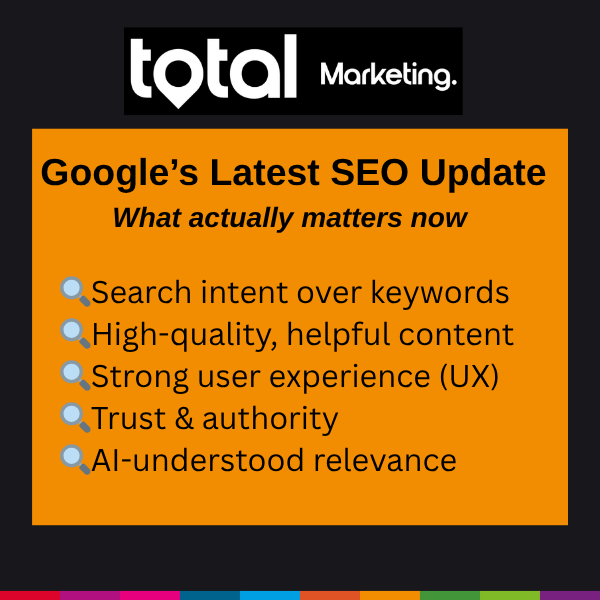
SEO, Search Engine Optimisation, is what most business owners already know. It's the reason some websites rank at the top of Google and others don't, built on things like keywords, backlinks, page speed and well-optimised metadata.
The goal of SEO is simple: get someone to click through to your website.
And to be clear, SEO still matters. Google isn't going anywhere, and a huge number of people still search the traditional way.
GEO, Generative Engine Optimisation, is about something slightly different. Instead of trying to rank on a page of blue links, GEO is about making sure AI tools actually pick up your content, trust it, and use it when answering someone's question.
The goal of GEO isn't to get clicked, it's to get chosen.
This is a real shift. SEO is still incredibly important, but now you also need to think about whether AI understands your business well enough to recommend it. If AI can't find clear, reliable information about your business online, there's a good chance it won't mention you at all, even if your website ranks well on Google.
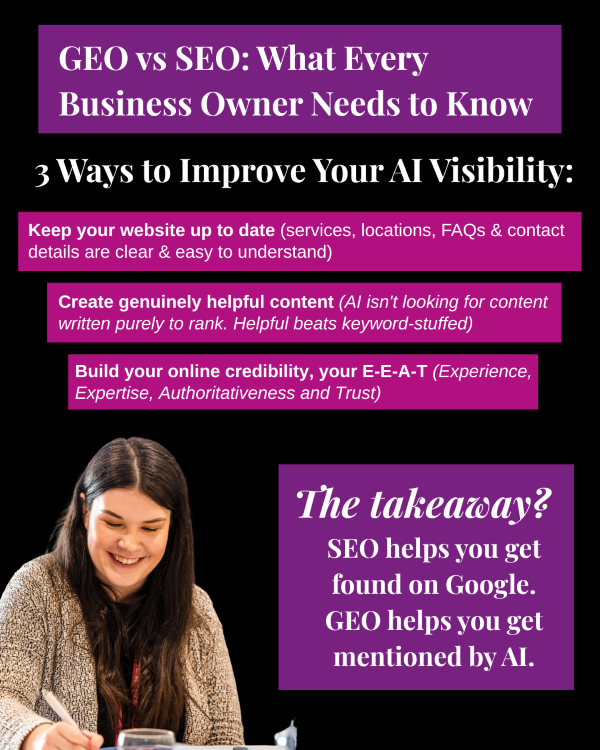
Make sure your services, locations, FAQs and contact details are clear and easy to understand. AI relies on accurate, well-structured information, so if your site is outdated or vague, AI simply won't trust it enough to use it.
This is a big one. AI isn't looking for content written purely to rank, it's looking for content that actually helps the person asking the question. Instead of only talking about your business, answer the questions your customers are already asking, clearly and honestly. Helpful beats keyword-stuffed, every time.
This one's worth remembering, it's one of the most useful concepts for GEO: E-E-A-T, Experience, Expertise, Authoritativeness and Trust. AI wants proof your business is the real deal. That means genuine reviews, being featured or mentioned on other reputable websites (ideally with them linking back to your site), and keeping your business information consistent everywhere it appears online.
The Bottom Line
The smart move isn't picking one over the other, it's doing both. Some of your customers are still Googling the traditional way. Others are asking AI instead. If you're only set up for one, you're missing out on the other.
It might sound like a lot, but it doesn't have to be complicated. It just means thinking about your content a little more broadly, being clear, being direct, and answering the questions your customers are actually asking, wherever they're asking them.
We've created an AI Visibility Report, showing whether your business is appearing in tools like ChatGPT, where the opportunities are, and what you can do to improve. Scan the QR Code to have a chat with Liz.

GEO stands for Generative Engine Optimisation. It's the practice of optimising your content so it gets picked up, trusted, and referenced by AI tools like ChatGPT, Perplexity, and Google's AI Overviews when someone asks a relevant question.
SEO (Search Engine Optimisation) focuses on ranking your website on traditional search engines like Google, with the goal of getting clicked on. GEO focuses on getting your content cited or mentioned directly by AI tools when they generate an answer, with the goal of getting chosen rather than clicked.
Yes. SEO and GEO work alongside each other rather than replacing one another. Many people still search using traditional Google, while a growing number ask AI tools directly. Businesses that only focus on one risk missing out on the other.
Three key things help: keeping your website accurate and up to date, creating genuinely helpful content that directly answers customer questions, and building your online credibility through reviews, mentions on reputable websites, and consistent business information across the web.
E-E-A-T stands for Experience, Expertise, Authoritativeness and Trust. It's a concept AI tools and search engines use to judge how credible and trustworthy a business or piece of content is. Strong E-E-A-T signals, such as genuine reviews and mentions on reputable websites, make AI more likely to reference your business.
Not entirely, at least not yet. Traditional Google search is still widely used, but AI search tools are growing quickly as an alternative way people find information. The safest approach for businesses is to optimise for both.
Phoebe Hooper is a Digital Marketing Executive and Account Manager, with a particular passion for SEO and helping local businesses grow their online visibility. After completing her A-levels in digital marketing, finance and business studies, Phoebe went on to achieve a distinction in her Level 3 Digital Marketing Apprenticeship.
She stays on top of the latest developments in search, including the rise of AI-powered search and GEO, to help businesses stay ahead of the curve.






We recommend



In case you missed it see what’s in this section
Listings