

In case you missed it see what’s in this section
We recommend

eating & drinking
Sponsored by

lifestyle
Sponsored by
entertainment
Sponsored by

Business
Sponsored by
property
Sponsored by
family
Sponsored by
shopping
Sponsored by

sport
Sponsored by

motoring
Sponsored by

Your Total Guide To Business

Google has rolled out several search updates during 2026, alongside the continued development of AI-powered search. For businesses, that creates plenty of headlines, unfamiliar terminology and questions about what actually matters.
The useful starting point? Understand what has changed, check your own website’s performance and focus on improvements that help your customers.
Google’s confirmed updates this year include core updates in March and May, spam updates in March, June, August and September, and a February update specifically affecting Google Discover.
These updates serve different purposes. Understanding the distinction helps you avoid treating every movement in rankings as the same problem.
Core updates make broad changes to Google’s ranking systems. Your position can change as Google reassesses which results best answer a search.
Spam updates improve how Google detects practices that breach its spam policies.
Discover updates affect the personalised content feed people browse through Google, rather than standard search listings.
The September spam update has now finished rolling out. However, its timing alone cannot tell you why an individual website gained or lost visibility.
A lower position is a reason to investigate, but it doesn’t establish that your business has done something wrong.
Start by looking at the pattern. Has one page dropped, or has traffic fallen across the website? Are fewer people searching for your service? Have competitors improved their pages? Has a recent website change affected important content?
Our recommendation is to assess changes using Google Search Console alongside your website analytics. Look at clicks, impressions, search terms and the pages affected, then compare equivalent periods while allowing for seasonality.
That gives you a clearer basis for action than checking one keyword on one day.
Google does not treat all AI-assisted content as spam. Its guidance recognises that generative AI can help with research and structuring original material.
The concern is creating large numbers of pages without adding value for readers.
For a business, the practical question is whether someone has checked the content and contributed something useful. Does it accurately explain your services? Does it answer your customers’ questions? Does it include knowledge or experience that a generic article would miss?
AI can help create a first draft. Your expertise, factual checks and editorial judgement should shape what gets published.
AI Overviews and AI Mode give businesses another way to be discovered within Google Search.
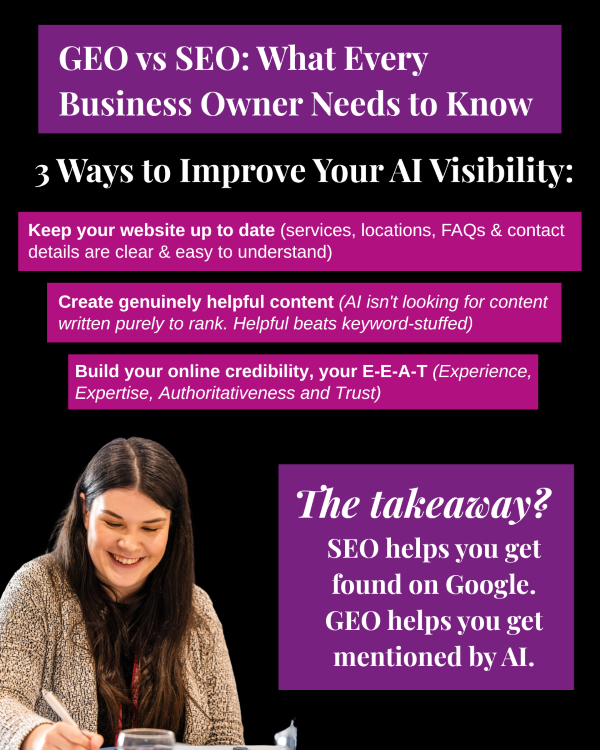
You may hear this discussed as generative engine optimisation, or GEO. However, Google says there are no additional requirements or special optimisations needed to appear in these features. Established SEO practices remain relevant.
For businesses, our advice is to keep important information accessible, explain your services clearly and make it easy for people to understand what you offer.
Clear headings and direct answers can improve a page’s usefulness. They don’t guarantee inclusion in an AI answer.
Give customers information they can act on
Think about what someone needs before enquiring or booking.
For a venue, that might include location, prices, age restrictions, accessibility and booking arrangements. For a service business, it could mean explaining who you help, what the service includes and what happens after an enquiry.
A page becomes more useful when it removes uncertainty.
Google’s guidance encourages original information and evidence of first-hand knowledge.
Your team’s expertise, real project examples, original photographs and considered explanations can give readers a reason to choose your content.
For example, a venue guide becomes more helpful when it explains who an experience suits and what visitors should know before arriving.
As a practical website housekeeping exercise, check whether several pages are trying to answer the same question.
Some may deserve distinct content. Others may work better combined. Review their purpose and performance before making changes, particularly before deleting pages that already attract visitors.
Check outdated prices, expired offers, old event dates and broken booking links.
Refreshing a page should improve its contents. Simply changing the date without making meaningful updates gives customers little benefit.
A longer introduction is only useful if it helps the reader. Add FAQs when they answer genuine questions, and use location references where they provide relevant context.
Avoid stretching a straightforward answer across several paragraphs just to make a page longer.
Choose a manageable starting point: review your most important service pages and the content that already brings people to your website.
Check accuracy, identify unanswered questions and add useful evidence of your experience. Then monitor enquiries, bookings and sales alongside search visibility.
At Total Marketing, we can help you review your website content and identify practical improvements, from clearer service pages to useful blogs and locally relevant guides.
Get in touch with Total Marketing to discuss your website content and SEO.
Phoebe leads the SEO and GEO team at Total Guide, where she has worked for seven years. She helps businesses improve their visibility across traditional and AI-powered search, turning complex search developments into clear advice and practical content strategies.







We recommend



In case you missed it see what’s in this section
Listings